-
American Constitutional Law: Essays, Cases, and Comparative Notes, 2nd ed.
Donald P. Kommers, John E. Finn, and Gary J. Jacobsohn
American Constitutional Law: Essays, Cases, and Comparative Notes is a unique casebook that encourages citizens and students of the Constitution to think critically about the fundamental principles and policies of the American constitutional order. In addition to its distinguished authorship, the book has two prominent features that set it apart from other books in the field: an emphasis on the social, political, and moral theory that provides meaning to constitutional law and interpretation, and a comparative perspective that situates the American experience within a world context that serves as an invaluable prism through which to illuminate the special features of our own constitutional order. While the focus of the book is entirely on American constitutional law, the book asks students to consider what, if anything, is unique in American constitutional life and what we share with other constitutional democracies. Each chapter is preceded by an introductory essay that highlights these major themes and also situates the cases in their proper historical and political contexts. This new edition offers updated and expanded treatment of a number of important and timely topics including, the death penalty, privacy, affirmative action, and school segregation
-
Evidence in Context: A Trial Evidence Workbook
James H. Seckinger, Robert P. Burns, and Steven Lubet
-
State v. Lawrence
James H. Seckinger, Frank D. Rothschild, Deanne C. Siemer, and Frank D. Rothschild
-
Civil Procedure
Jay Tidmarsh, Thomas D. Rowe, and Suzanna Sherry
Professors choosing a civil procedure book have always faced difficult dilemmas. The "breadth vs. depth" trade-off is particularly acute in this field, and the matter is complicated by the fact that civil procedure might be allocated as few as 3 or as many as 6 credits. This book aims to ease that dilemma by structuring the material so that it can be taught quickly but at a high levels; the cases and notes are short but intellectually challenging. At less than 700 pages, most of the book can be covered in as few as 4 credit hours, but the materials are rich enough to expand discussion to 6 credit hours. For each individual topic, it is possible to use this book to cover the basics or to probe the issues in depth, depending on the time allocated. The book also introduces students to the themes that run through civil procedure: efficiency and fairness, the advantages and disadvantages of the adversarial system, real-life litigation strategies, and issues of federalism and separation of powers inherent in the American judicial system. Each chapter begins by exploring these themes through excerpts from scholarship in the field, and is followed by notes and questions. The cases have been chosen to capture the students' interest as well as to teach the topics.
-
Cyberlaw: Problems of Policy and Jurisprudence in the Information Age. 1st ed.
Patricia L. Bellia, Paul Schiff Berman, and David G. Post
This law school casebook starts from the premise that cyberlaw is not simply a set of legal rules governing online interaction, but a lens through which broader issues can be re-examined. The book goes beyond simply plugging Internet-related cases into a series of pre-existing categories, instead emphasizing conceptual debates that cut across the areas of doctrine touched by cyberspace. It also uses the rise of the Internet to encourage readers to reconsider various assumptions in traditional legal doctrine, providing training in Internet-related legal issues while making the argument that cyberlaw is a coherent and useful field of study.
-
Konflikt Der Rechtskulturen? Die USA und Deutschland Im Vergleich
Donald P. Kommers
Book Chapter
Donald P. Kommers, The Grundgesetz: An American Perspective, in Konflikt Der Rechtskulturen? Die USA Und Deutschland Im Vergleich 37 (Knud Krakow & Franz Streng eds., 2003)
The volume's contributions look at the legal system of the United States of America as part of the overall national culture, compare it with the corresponding German ideas, and analyze it in a number of key aspects. The respective basic issue is, above all, the respective weighting of freedom and equality, as well as the resulting constitutional orders. Other issues include the relationship between national, international and global law; the impact of racial and gender prejudice on case law, especially in the case of the death penalty; juvenile justice and the consequences of a zero tolerance policy; the right to damages and the relationship between law, the media and the public.
-
Gleichheit und Nichtdiskriminierung im nationalen und internationalen Menschenrechtsschutz
Donald P. Kommers and Stephanie E. Niehaus
Book Chapter
Donald P. Kommers & Stephanie E. Niehaus, An Introduction to American Equal Protection Law, in Gleichheit und Nichtdiskriminierung im nationalen und internationalen Menschenrechtsschutz 25 (Rüdiger Wolfrum ed., 2003)
The book compares the application of the principle of equality and the prohibition of discrimination in selected national legal systems (US, France, Germany, Israel, South Africa) and international human rights protection (EC / EU, ECHR, Inter-American human rights protection, African human rights protection, human rights protection within the framework of the UN, Racial discrimination, minority protection). It also includes contributions to cross-cutting issues (the relationship between equality and non-discrimination, the importance of the principle of equal treatment for the constitutional review of laws, the universality of human rights). In doing so, particular problems in the application of the law will be presented - mainly by practitioners dealing with the questions - and current developments in their solution will be shown.
-
International Dispute Settlement
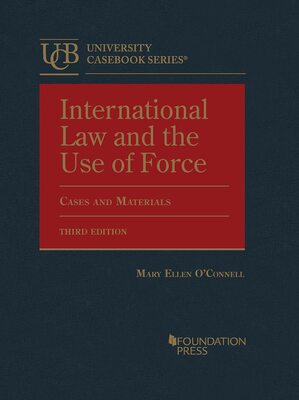
Mary Ellen O'Connell
The very purpose of international law is the peaceful settlement of international disputes. Over centuries, states and more recently, organizations have created substantive rules and principles, as well as affiliated procedures, in the pursuit of the peaceful settlement of disputes. This volume of "The Library of Essays in International Law" focuses on the classic procedures of peaceful settlement: negotiation, good offices, inquiry, conciliation, arbitration, judicial settlement and agencies for dispute resolution. The introduction provides an historic overview, explaining how the procedures first developed and changed over time. Each chapter features a seminal essay that helped create the changes described in the introduction.
-
Teacher's Manual for Lawyers, Clients and Moral Responsibility
Thomas L. Shaffer, Jeffrey D. Bauman, Elliott J. Weiss, and Alan R. Palmiter
-

Enron, Accounting, and Lawyers
Matthew J. Barrett
Enron's collapse painfully illustrates the importance of financial accounting to all lawyers. Accounting is often referred to as "the language of business." Virtually every lawyer represents businesses, their owners, or clients with adverse legal interests, such as creditors and customers. Especially after Enron, lawyers cannot competently represent clients if they do not grasp certain basic principles about accounting. This article lists the top ten accounting lessons that any lawyer could learn from the scandal. These lessons include the components of a complete set of financial statements, the choices inherent in generally accepted accounting principles, the distortions possible in pro forma reporting, auditor independence, related-party transactions, internal controls, revenue recognition, guarantees, the accounting for the issuance of shares, and professional responsibilities related to questionable accounting policies or practices.
-
Federal antitrust law : a treatise on the antitrust laws of the United States
Joseph P. Bauer, Earl W. Kintner, William P. Kratzke, and William H. Page
This master treatise provides a comprehensive analysis of the development and current status of antitrust law, as well as practical guidance for the application of that law.
The brevity and generality of the language of relevant acts, combined with the ever-increasing volume of antitrust litigation and varying philosophies of enforcement and interpretation by courts and agencies, makes Federal Antitrust Law indispensable to corporate counsel, government attorneys, and private practitioners specializing in antitrust law.
Three volumes focus exclusively on nearly 75 years of Federal Trade Commission work, a subject neglected in other antitrust works. Includes thorough examinations of the FTC Act; FTC organization, enforcement and regulatory procedures; deceptive nondisclosure; price advertising and savings claims; business and employment opportunities; and credit and collection practices.
Textual discussion is extensively footnoted with references to all significant decisions of the FTC and federal courts; relevant sections of the United States Code; legislative materials; administrative rules; executive orders; rules of evidence and procedure; state statutes; and important treatises, publications and legal periodicals.
-
Potter v. Shrackle and the Shrackle Construction Company Case File
Kenneth S. Broun, Frank D. Rothschild., and James H. Seckinger
The problems in this book are intended to simulate realistic courtroom situations. Advance preparation is essential to their successful utilization as instructional materials.
-
Cases, Text and Problems on Federal Income Taxation, 5th ed.
Alan Gunn and Larry D. Ward
Early in the book the students encounter fundamental tax concepts such as basis, case-method, and accrual-method accounting; depreciation; and gain from the sale of property. Later chapters apply these principles in more difficult settings. This organization allows students to develop their understanding of key concepts in simple settings, and then to review and reinforce these concepts. Contains a large number of purposely brief problems and textual notes on tax policy, progressive taxation, preferences for capital gains, the exclusion of gifts and bequests from income, the taxation of life insurance, and the relevance of state law determinations to federal tax disputes.
-
Criminal and Scientific Evidence: Cases, Materials and Problems, 2nd ed.
Jimmy Gurule and Robert J. Goodwin
-
Defining the Field of Comparative Constitutional Law
Donald P. Kommers
Book Chapter
Donald P. Kommers, Comparative Constitutional Law: Its Increasing Relevance, in Defining the Field of Comparative Constitutional Law 61 (Vicki C. Jackson & Mark V. Tushnet eds., 2002)
Jackson, Tushnet, and their contributors, distinguished jurists and legal scholars from around the world, seek to define the field of constitutional law, sometimes expressly but more often by illustrating the way in which each writer thinks about comparative constitutional law. Viewed as a whole, the collection points to common constitutional themes even though how nations responded to these issues differed substantially based on different histories, traditions, and experiences.
-
Tradition und Weltoffenheit des Rechts: Festschrift für Helmut Steinberger
Donald P. Kommers
Book Chapter
Donald P. Kommers, Die freie Meinungsauberung in der Rechtsprechung des Bundesverfassungsgerichts und des Supreme Court: Ein Vergleich, in Tradition und Weltoffenheit des Rechts: Festschrift für Helmut Steinberger 805 (Hans-Joachim Cremer et al. eds., 2002)
In the Festschrift recognized German and foreign representatives from science and practice deal with problems of international law, German and foreign public law and European law, to which the jubilee has devoted himself in his professional work as a scientist and judge of the Federal Constitutional Court. The total of 66 contributions in German, English and French are divided into four subject headings:
- International Law;
- constitutional law;
- foreign public law and comparative law;
- European integration and ECHR. -
Moral Memorandua from John Yoder: Conversations on Law, Ethics, and the Church between a Mennonite Theologian and a Hoosier Lawyer
Thomas L. Shaffer
Moral Memoranda from John Howard Yoder compiles fifteen years of advice and comment on low and government in the United States from o leading theologian who was as prominent for the wisdom he offered to mainline Christians as he was o resource and teacher within his own Mennonite Church. This volume of letters, notes, and essays combines deep understanding of Professor Yoder's Anabaptist tradition with insightful, sometimes wry, observation on modern American Catholicism, and an occasionally caustic but more often open, inquiring interest in law, lawyers, and legal education.
-
Complex Litigation: Problems in Advanced Civil Procedure
Jay Tidmarsh and Roger H. Trangsrud.
Offers concepts of and insights into the forms and functions of complex litigation issues, including their implications. Helps students in such courses to review and study, as well as serves as a reference book for students once they are in practice.
-
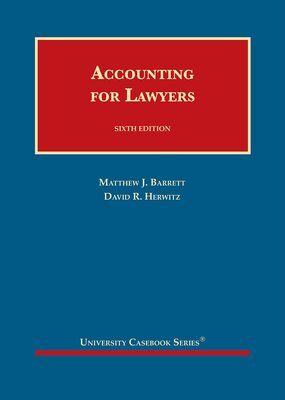
Materials on Accounting for Lawyers, 3rd ed.
Matthew J. Barrett and David R. Herwitz
The fourth edition uses a "learn by doing" approach. Its Teacher's Manual augments the casebook with alternative problems for each chapter, additional materials and references to accounting promulgations. Its four suggested syllabi make it a tool for adapting the casebook to two- and three-credit hour basic courses or a two-credit hour advanced course.
-
Materials on Accounting for Lawyers, Concise 3rd ed.
Matthew J. Barrett and David R. Herwitz
Uses a "learn by doing" approach. Its Teacher’s Manual augments the casebook with alternative problems for each chapter, additional materials and references to accounting promulgations. Its four suggested syllabi make it a tool for adapting the casebook to two- and three-credit hour basic courses or a two-credit hour advanced course.
-
Baseball and Antitrust: The Legislative History of the Curt Flood Act of 1998
Edmund P. Edmonds and William H. Manz.
-
Human Rights Module: On Crimes Against Humanity, Genocide, Other Crimes Against Human Rights, and War Crimes
Jimmy Gurule and Jordan J. Paust
The Human Rights Module provides an up-to-date exploration of the "core" international crimes most often associated with human rights infractions for those interested in human rights and for use in international law courses, human rights courses, or seminars. "Core" crimes include crimes against humanity, genocide, other crimes against human rights (such as torture, criminalized race discrimination, apartheid, hostage-taking, and disappearances), and war crimes. There is also a separate chapter on sanctions against Karadzic that applies many of the core crimes in both criminal and civil sanctions arenas (before the International Criminal Tribunal for former Yugoslavia and the U.S. federal courts) with respect to one setting: the conflict in Bosnia-Herzegovina. This book is an excellent resource for courses focusing on crimes against humanity, genocide, and other crimes against human rights (and/or war crimes). Author Jordan J. Paust presents cases and materials in Part One and documents in Part Two. These sections may be used separately or in different groupings as relevant to particular needs. Non-scholarly readers interested in human rights will also find the book informative.
The “Books” section of the Notre Dame Law School Scholarship Repository is a large digital bibliography and archive of books, casebooks, edited volumes, and monographs authored or edited by Notre Dame Law School faculty. It represents decades of faculty scholarship across many areas of legal study–reflecting both scholarly and instructional publishing. Recurring themes include comparative and international law and interdisciplinary scholarship. Natural law and moral philosophy emphasize Notre Dame’s longstanding engagement with Catholic intellectual traditions and jurisprudence.
Printing is not supported at the primary Gallery Thumbnail page. Please first navigate to a specific Image before printing.